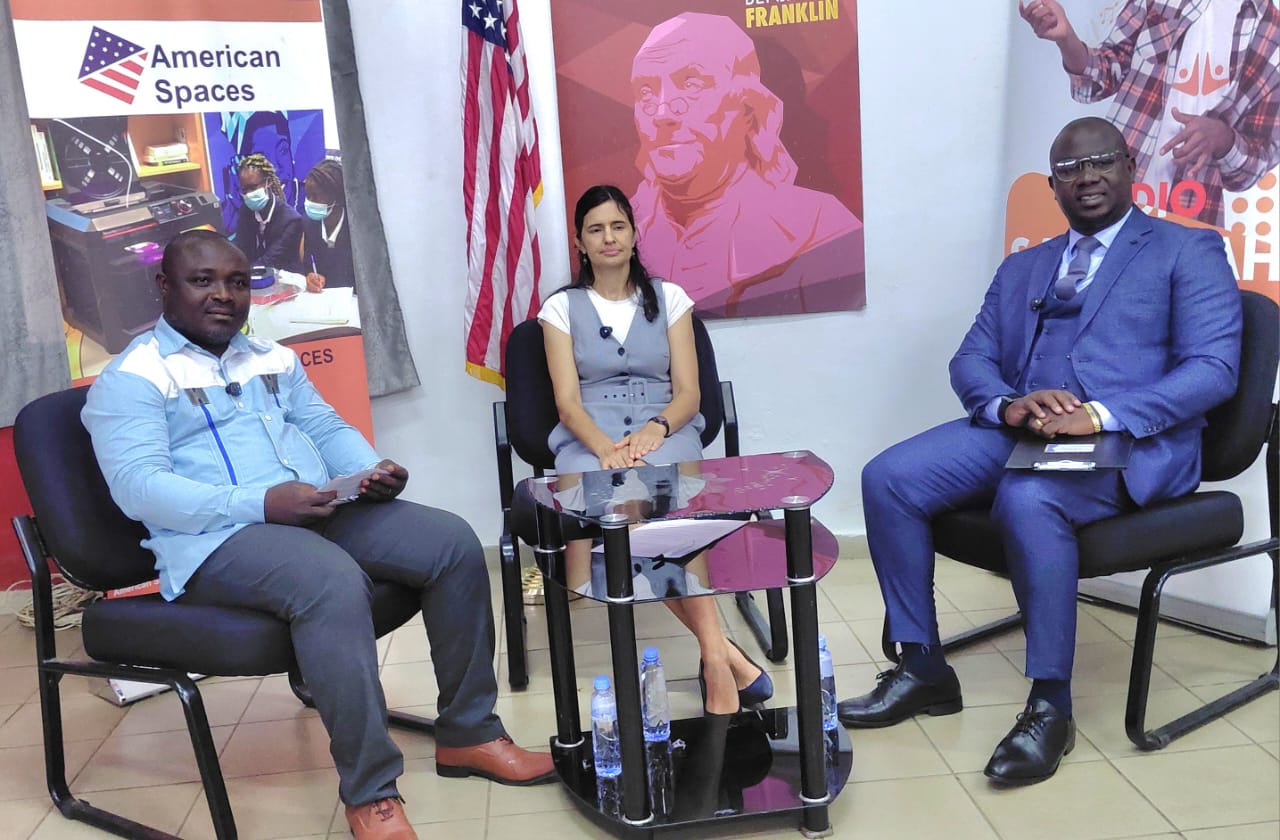
On Monday, September 14, 2026, the Ivorian government inaugurated the campus and used the occasion to hold the official ceremony marking the start of the 2026-2027 academic years. Attending the ceremony, MCC Resident Country Director for Côte d'Ivoire Sonia Shahrigian described the new ENS as a symbol of a partnership between the two countries that is stronger than ever.
The facility is part of a project called "Skills for Employability," with a total budget of 200 million US dollars, according to details provided by the MCC Country Director in an exclusive interview granted to Akwabanews.ci and Savannah FM at the American Space in Bouaké.
Construction and equipment for the Bouaké ENS mobilized approximately 6 billion CFA francs. The goal: to better train the teachers, who will, in turn, educate Ivorian youth in schools across the country.
An Investment Designed to Prepare Tomorrow's Teachers
For the MCC representative, this funding is far from an isolated gesture. It reflects an objective shared by both countries: strengthening economic ties between the United States and Côte d'Ivoire by investing in education. Once deployed to schools across the country, the future teachers trained at the Bouaké ENS will be responsible for preparing a generation of young people capable of meeting labor market demands and contributing to national economic growth.
Nor was the choice of Bouaké as host city incidental. As Côte d'Ivoire's second-largest city, it embodies, according to Sonia Shahrigian, a dynamism and set of opportunities that the United States wants to support. "We see here in Bouaké the economic future of Côte d'Ivoire," she said, recalling a city where she had already had the opportunity to contribute to the construction of a local secondary school and to support technical and vocational education.
The American Space: Another Pillar of Cooperation with Youth
Beyond the ENS, American cooperation in Bouaké has, for over a decade, relied on the American Space, which opened in 2013. The center offers free English classes along with training in entrepreneurship, artificial intelligence, and computer networking. According to the MCC's country head, more than 1,200 programs have been organized since the American Corners and Spaces opened, reaching more than 82,000 people.
The Bouaké American Space also serves as a capacity-building platform for local journalists, with resource people who often travel from the United States. She further noted that the American Space provides the computer equipment and documentation needed for training and capacity-building of journalists from the region and its surrounding areas. Each year, the US Embassy provides free training to journalists in several cities across Côte d'Ivoire. On the technology front, the US government wants to give young Ivorians the tools to turn their ingenuity into concrete projects, particularly in artificial intelligence and digital entrepreneurship.
Taking the opportunity to speak further, Sonia Shahrigian praised the motivation of Bouaké's population in working toward the city's well-being. "I see a great deal of potential in Bouaké, it's a city where people are highly motivated to move forward and pursue a better future. We're trying to make our own small contribution. We're trying to attract both Ivorian and American private-sector investment to nurture the goodwill we find here," she said.
Addressing the new school year, she extended her wishes for success to pupils, students, and the families sending their children back to school during this period.
The United States and Côte d'Ivoire are counting on this compact to reshape teacher training in the country. But between the inauguration of a campus and its real contribution to the Ivorian education system, the first field-level assessments will have to wait in the classrooms where these teachers will ultimately be posted across the country.
François M'BRA II